![99745fd6-afc8-495e-a1a1-c5fa6c1501aa.png]](https://resources.spectotechnology.com/hs-fs/hubfs/99745fd6-afc8-495e-a1a1-c5fa6c1501aa.png?width=300&height=113&name=99745fd6-afc8-495e-a1a1-c5fa6c1501aa.png)
What is Sound?
Sound is a vibration that travels through a medium such as air, water, or solids in the form of pressure waves. When an object vibrates, it pushes and pulls on surrounding air molecules, creating areas of high and low pressure that travel outward as sound waves.
How Sound Waves Travel
Sound waves move through the air as alternating patterns of compression and rarefaction. Compression occurs when air molecules are pushed together, creating higher pressure. Rarefaction occurs when molecules spread apart, creating lower pressure. As these waves reach the ear, they cause the eardrum to vibrate, which the brain interprets as sound.
Loudness and Decibels
Sound levels are measured in units called decibels (dB). The decibel scale is logarithmic, which means increases in sound level represent exponential increases in sound energy.
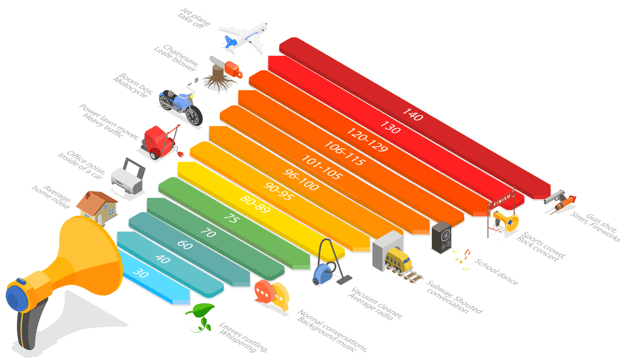
Understanding the Frequency Spectrum
Frequency describes how fast sound waves vibrate and determines the pitch of a sound. Frequency is measured in Hertz (Hz), which represents the number of wave cycles per second. The typical human hearing range is approximately 20 Hz to 20,000 Hz.
Measurement Function
- Measurement Function offers a filtering method of splitting the audible spectrum into smaller segments called octaves, allowing you to identify different noise levels across individual frequencies.
- Level Meter:
- Octave 1⁄1: (Full Octave band)
- Octave 1⁄3: Each 1/1 (single) Octave is further split into three, providing a more detailed view of noise content.
Frequency Weighting
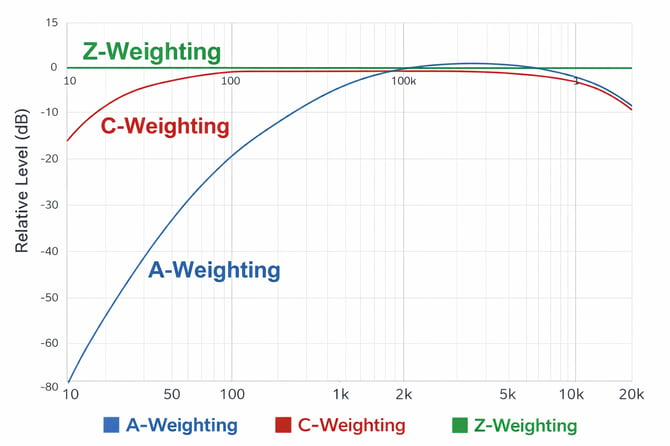
Different frequency weightings are used when measuring sound to represent how sound is perceived or to analyze the physical characteristics of noise.
-
A-Weighting (dBA): Mimics how the human ear hears sound. It reduces low and very high frequencies and is commonly used for environmental noise monitoring.
-
C-Weighting (dBC): Has a flatter response and captures more low-frequency energy. It is often used when measuring louder sounds or industrial noise.
-
Z-Weighting (dBZ): A flat, unweighted response that captures all frequencies equally. It is commonly used for detailed acoustic analysis and engineering studies.
Time Weighting
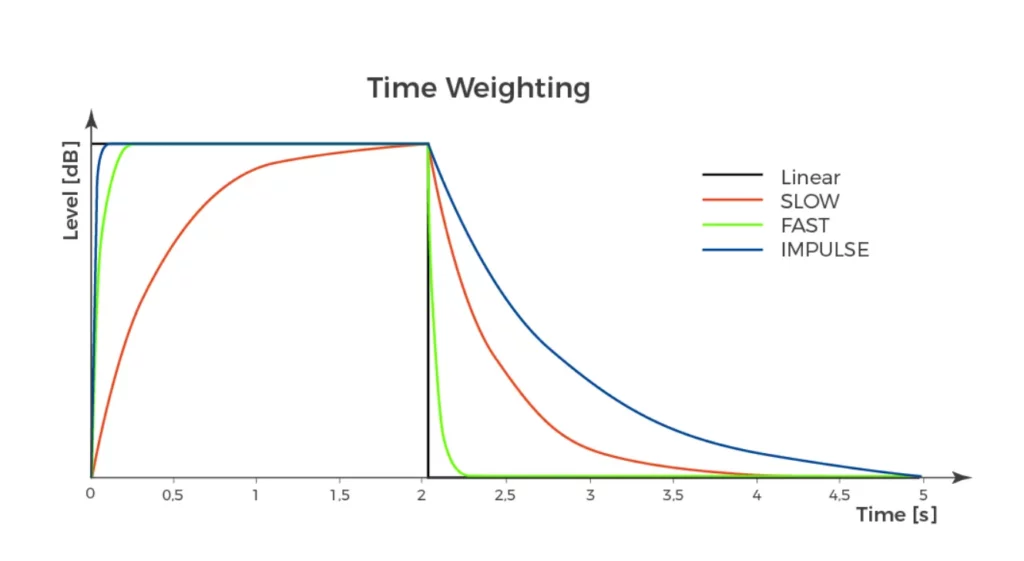
Time weighting describes how quickly a sound measurement responds to changes in sound level. Two commonly used settings are:
- Fast (F) - Responds quickly to sound changes
- Slow (S) - Smooths rapid fluctuations in sound
RMS/LEQ Integration
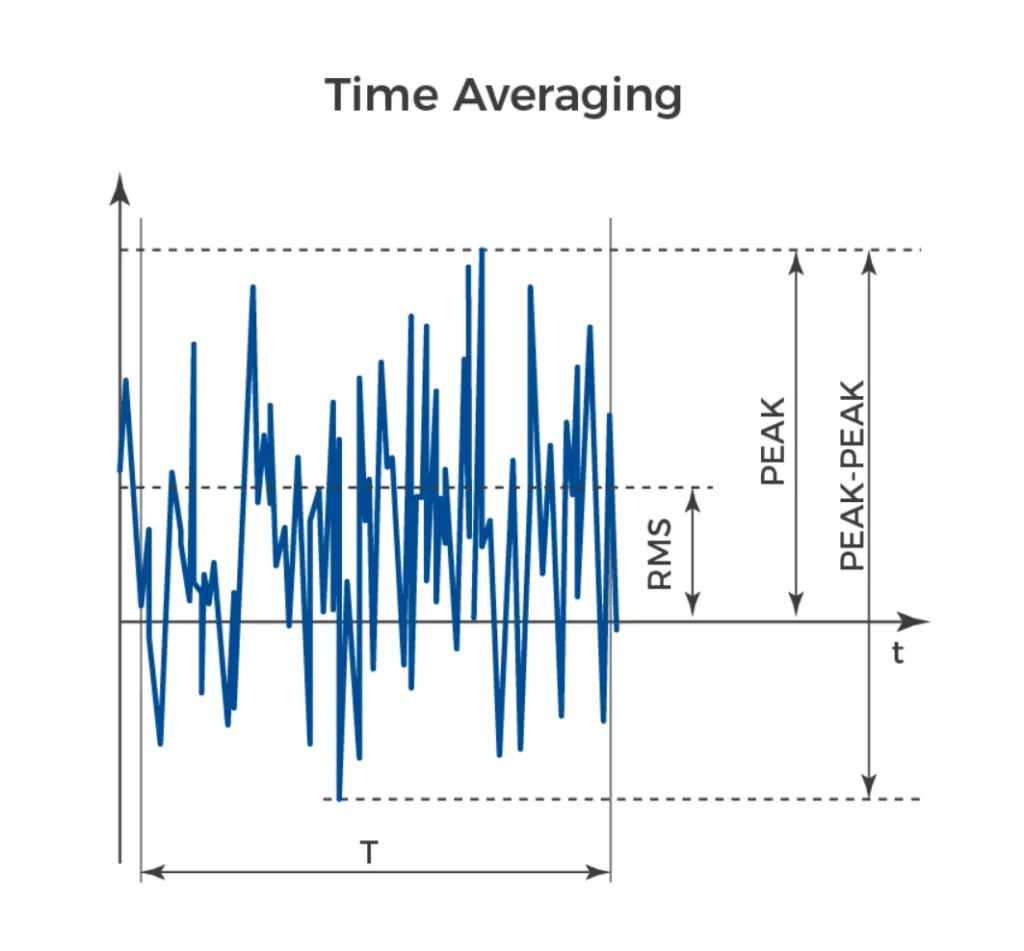
- LEQ represents the equivalent continuous sound level. It’s the steady sound level that contains the same total energy as a varying sound measured over a given time period.
- Linear: calculates only the total sound energy over a specified time frame. Unlike Fast, Slow, or Impulse detectors, it does not apply an exponential decay. For more details, refer to “Exponential Integration.”
- Exponential: time constant in seconds for the given time-weighting
Common Noise Metrics
Metrics allow engineers, environmental consultants, and regulators to:
-
Understand overall noise conditions
-
Identify loud events
-
Compare noise levels against regulations
-
Analyze long-term trends
Without metrics, noise monitoring would produce thousands of raw sound readings that are difficult to interpret.
-
Leq (Equivalent Continuous Sound Level) -Represents the average sound energy over a specific period of time, using (A, C, or Z) -weighting.
- L(A, C, or Z)F - Level calculated with (A, C, or Z)-weighted frequencies and Fast-weighted time.
- LMax (Maximum Sound Level) - The highest sound level measured during the period.
-
LMin (Minimum Sound Level) - The lowest sound level measured during the period.
Ln Metrics (Statistical Noise Levels)
In industrial and environmental acoustics, the Sound Intensity Level (LI) is a logarithmic measure used to describe the magnitude of acoustic energy flow.
- L = Sound level
- n = Percentage of time the sound level is exceeded
- Ln = the noise level that is exceeded for “n%” of the time
In reference to ISO 9614, the Sound Intensity Level is calculated using the following equation:
LI=10*log10(I/I0)
- I: The measured sound intensity, representing the energy flow per unit area (W/m2)
- I0: The standard reference sound intensity, defined as 1 pW/m2
- Unit: The result is expressed in decibels (dB)
- L10 - shows louder intermittent sounds (Ex. trucks passing)
- L50 - shows the midpoint noise level (what you hear most of the time)
- L90 - represents the background noise(what it sounds like when things are mostly calm)
Glossary
- Background Noise: The ambient sound level present in an environment when no dominant sound source is active.
-
Decibel (dB): A logarithmic unit used to measure sound pressure level.
-
Frequency: The rate at which sound waves vibrate, measured in Hertz (Hz).
-
LAeq: The equivalent continuous sound level representing the average sound energy over time.
-
Lmax: The highest sound level recorded during a measurement period.
-
Lmin: The lowest sound level recorded during a measurement period.
- Noise: Unwanted or disruptive sound that interferes with normal activities.
- Sound: A vibration that travels through a medium such as air in the form of pressure waves.
- Sound Exposure Level (SEL): an acoustic metric that measures the total sound energy of a single noise event (like an aircraft flyover or vehicle pass-by) by "squeezing" that total energy into a standardized 1-second period.
-
Sound Pressure Level (SPL): A measurement describing the intensity of sound.